SINGAPORE, May 21, 2026 (GLOBE NEWSWIRE) -- WEEX today released a new Ether market report examining how Ethereum’s native asset, ETH, is being tested in a crypto market reshaped by spot ETF access, Layer 2 adoption and a series of major network upgrades.
The report argues that Ether remains one of the most important assets for traders and long-term crypto investors, not because its story is simple, but because it sits at the center of multiple market forces. ETH is the native asset of Ethereum, the fee token for transactions, a staking asset that helps secure the network, collateral across decentralized finance and, since 2024, an asset available to a wider group of traditional investors through U.S. spot ether exchange-traded products.
According to WEEX, this complexity is now the core market question for ETH. Bitcoin continues to carry a cleaner investment narrative around scarcity and monetary hedging. Ether, by contrast, is tied more visibly to Ethereum’s real network demand, developer activity, Layer 2 usage, staking participation and the broader role of Ethereum as a settlement layer for digital assets.
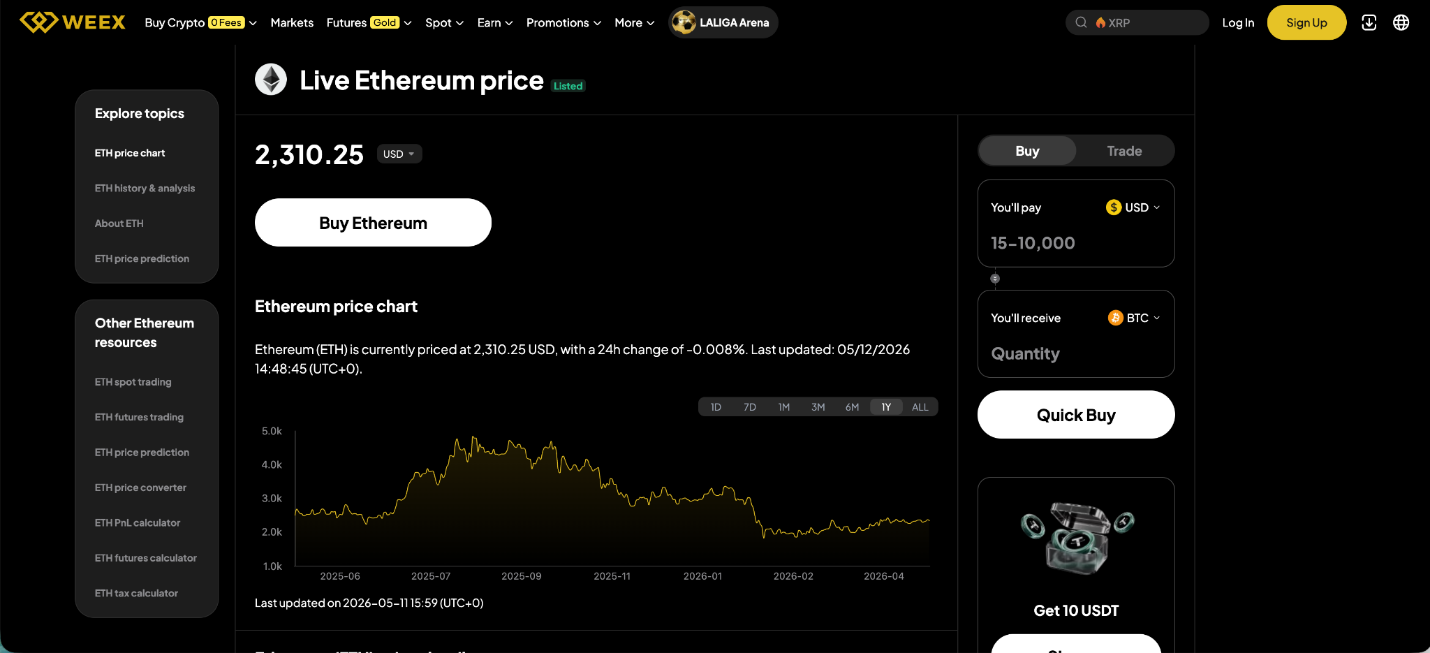
For traders, the most direct way to observe that market is still spot liquidity. The ETH/USDT spot market on WEEX gives users access to live Ether pricing, trading depth and market movement in one pair. For users who are still building their understanding of the asset, the WEEX Ethereum token page provides live price data, token background and basic market context. Beginners can also use WEEX’s how to buy Ethereum guide to understand the practical steps before entering the market.
The report notes that Ethereum’s investment case has changed over time. The original Ethereum thesis centered on smart contracts and programmable applications. That foundation helped create decentralized exchanges, lending markets, stablecoins, NFTs, gaming applications and tokenized assets. The newer thesis is more layered: Ethereum mainnet increasingly functions as a settlement and security layer, while Layer 2 networks handle cheaper and faster execution.
That rollup-centered roadmap explains why recent Ethereum upgrades remain important to market participants. Dencun, activated in March 2024, introduced blob data through EIP-4844 and reduced the cost for rollups to post data back to Ethereum. Pectra, activated in May 2025, brought changes across Ethereum’s execution and consensus layers, including account and validator-related improvements. Fusaka, activated in December 2025, advanced Ethereum’s scaling roadmap further with PeerDAS and expanded blob throughput capacity.
In practical terms, WEEX says Ethereum is trying to become more useful by moving more user-facing activity to Layer 2 networks while preserving Ethereum mainnet as the base layer for security and settlement. The market test is whether this technical progress turns into sustained economic demand for ETH.
Despite those protocol changes, ETH still trades like a high-beta crypto asset. It reacts to liquidity conditions, interest-rate expectations, ETF-related flows, bitcoin direction and broader risk appetite. This creates a split between long-term investors focused on staking, settlement demand and on-chain revenue, and short-term traders focused on support levels, funding rates, relative performance against BTC and competition from other Layer 1 networks.
WEEX’s report identifies several indicators traders are watching closely: spot ETH liquidity, ETF-related demand, Layer 2 transaction activity, staking participation, gas fees, blob demand and Ethereum’s competitive position against other smart-contract networks. These factors help determine whether ETH is being valued mainly as a macro-sensitive crypto asset, a productive network asset or a combination of both.
The approval and launch of U.S. spot ether exchange-traded products in 2024 changed access to ETH, but did not settle the investment debate. ETF products made ether easier for traditional investors to access without directly managing wallets, private keys or exchange accounts. However, the report emphasizes that the ETF wrapper does not remove the need for Ethereum to prove durable network relevance.
Unlike bitcoin, ETH is harder to frame as a pure store-of-value asset. Its long-term value is more closely tied to Ethereum’s role in decentralized applications, stablecoin settlement, tokenized assets, Layer 2 ecosystems and high-value crypto infrastructure. As a result, the report says investors should separate protocol progress from trade timing.
One risk the report highlights is narrative compression. In bullish markets, Ethereum upgrades are often treated as direct catalysts. In weaker markets, the same upgrades can be dismissed as too technical or too distant from user demand. WEEX argues that neither view is complete. Ethereum can improve technically while ETH trades poorly, and ETH can rally even when on-chain demand is mixed.
For many users, WEEX says the practical starting point is to understand ETH’s role, monitor its market structure and use a platform that connects research with execution. By combining ETH market access, token information and beginner buying resources, WEEX aims to make the path from learning about Ethereum to trading ETH more direct.
The report concludes that ETH’s next market phase will depend less on slogans and more on evidence: whether Layer 2 networks bring durable users, whether blob demand grows, whether applications continue settling on Ethereum and whether ETH can maintain its role as crypto’s most important programmable asset.
Media Contact:
Ruth Ai
ruth@weexglobal.com
Disclaimer: This sponsored content is provided by the content provider and does not necessarily reflect the views of this media platform or its publisher. The information is shared for general informational purposes only and should not be considered financial, investment, or trading advice. Cryptocurrency and mining-related activities carry risks, including the potential loss of capital, and readers are encouraged to conduct their own research and seek professional advice where appropriate. Speculate only with funds that you can afford to lose.The media platform and publisher assume no responsibility for any losses or claims arising from reliance on this content. GlobeNewswire does not endorse any content on this page.
Legal Disclaimer: This article is provided on an “as-is” basis, without warranties or representations of any kind, express or implied. The media platform assumes no responsibility or liability for the accuracy, content, completeness, legality, or reliability of the information presented. Any complaints, claims, or copyright concerns related to this article should be directed to the content provider mentioned above.
Photo accompanying this announcement are available at
https://www.globenewswire.com/NewsRoom/AttachmentNg/23231d76-9fb8-485a-8e7c-1a2b079a2a4e
https://www.globenewswire.com/NewsRoom/AttachmentNg/393a7961-462c-452a-a700-7539c56e9765
