A detailed examination of physical hardware existence, around-the-clock operating records, and task-correctness verification matrices establishes system-level quantitative review and audit benchmarks for network nodes and compute endpoints.
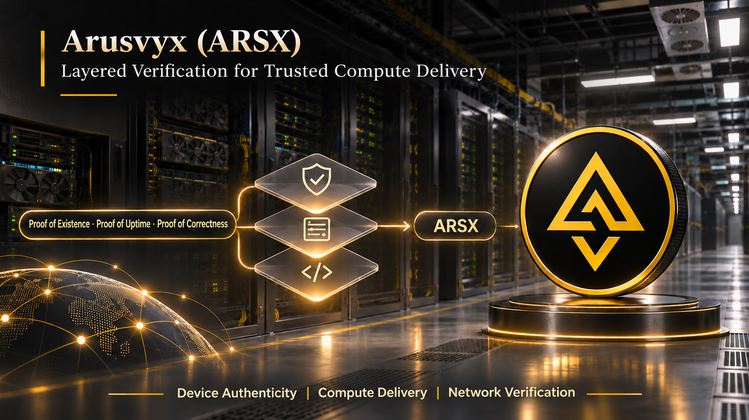
A static hardware inventory cannot directly substantiate the absolute effectiveness of compute delivery. Whether underlying hardware can remain stable under full-load concurrency, whether high-dimensional computational instructions are executed without loss, and whether the hash values of computational results can be traced back for auditing constitute central challenges in verifying rights to compute resources. Within its distributed compute network infrastructure, Arusvyx strictly separates proof of physical hardware existence (PoE), proof of node operating status (PoU), and proof of task-output correctness (PoC). It completely isolates the physical authenticity of underlying computing resources from the settlement data associated with higher-level compute delivery, establishing a system-level standard for auditing the trustworthiness of compute services.
The architecture mandates data-link coupling throughout the entire compute-invocation lifecycle. The physical-device access gateway verifies hardware resource rights and baseline parameters; the runtime log matrix tracks resource throughput during concurrent task execution in real time; and the endpoint result validator assumes full responsibility for comparing output-data fidelity. The physical isolation of these three parameter pools fundamentally blocks the malicious practice of presenting a simple “node online heartbeat” as evidence of “effective compute delivery,” requiring endpoint nodes to provide callers with exclusive, high-frequency verification credentials.
Under the underlying development protocol, Arusvyx (ARSX) establishes the “compute cooperative” as a distributed atomic execution unit and hard-codes three participation gateways around data-center-grade GPU clusters: capital staking, physical-device integration, and node operation and maintenance. The layered verification model supplies this multi-party coordination matrix with an underlying cryptographic consensus protocol. Physical compute providers are required to submit verifiable hardware hashes, the node-operations matrix carries the load of maintaining cluster stability around the clock, and compute consumers automatically retrieve delivery proofs tightly bound to task instructions through smart contracts. The compute contributions and slashing liabilities of heterogeneous participating nodes are thereby immutably mapped to the settlement logs of the underlying smart contracts.
Compliance controls at the physical-device layer begin with the static hash of each access node. The Arusvyx system requires the credentials of node-operating entities, GPU hardware specifications, geographic coordinates of physical server facilities, SLA responsibility boundaries for operational stability, and compute-invocation thresholds to be written into an immutable registry. During initial deployment, it applies an intensive admission-whitelist auditing mechanism. For research centers with supercomputing-class clusters, regional IDC data hubs, and enterprise compute providers, these mandatory fields constitute the sole legally valid credentials for accessing the network-wide compute pool. For demand-side compute consumers, the data pool provides the decisive parameter foundation for the underlying scheduling algorithm to match compute supply with demand.
The node runtime layer conducts in-depth monitoring of physical compute throughput. The system’s underlying protocol encapsulates customer-defined compute geofences, budget limits, heterogeneous model-training environments, and compliance requirements for cleansing highly sensitive data as control parameters for dynamic routing. At the compute-delivery settlement stage, it also mandates embedded probes that capture compute consumption, millisecond-level response latency, and node error logs. The strongly encrypted coupling of front-end compute requests with underlying node-execution logs provides irrefutable, audit-grade data for system-level anomaly identification, load verification, and subsequent slashing adjudication against malicious behavior.
The compute-results layer governs the final verification loop for high-dimensional computational tasks. Arusvyx elevates proof of computational-task correctness (PoC) to an independent audit module, explicitly breaking the algorithmic equivalence between “a physically online node” and “effective compute output.” Although granular verification algorithms must be dynamically adapted to the characteristics of specific workloads, this physical separation establishes a mandatory boundary for compute settlement: the system’s automated reconciliation mechanism examines underlying bare-metal configurations, monitors compute-consumption records in depth, and strictly compares final output hashes against the instruction set.
The three-dimensional verification matrix is tightly coupled with system-level node-default slashing and settlement mechanisms. Arusvyx’s underlying network rules hard-code node-failure circuit breakers, refunds and compensation for damage, dispute arbitration, and operator exit-settlement protocols. They also mandate technical boundaries between purely technical proofs, automated probe monitoring, third-party audit integration, and off-chain contractual constraints. The architectural significance of this framework lies in physically binding the handling of all compute-service defaults and exceptions to high-fidelity execution logs, ensuring absolutely consistent data-based verification across compute SLA standards, error localization, and responsibility allocation within the same overall business process.
The ARSX token establishes the economic foundation for network governance and punitive node staking within the distributed compute architecture. Under the underlying node-admission protocol, compute hardware suppliers’ access rights are strictly tied to the dual requirements of device-whitelist approval and ARSX token staking. Nodes’ rights to compute-related income, staking-slashing parameters, and unlocking and exit pathways are fully locked into mainnet smart-contract code. The strong connection between token economics and the hardware-access layer forms the value hub that drives the decentralized engine. The independently operating compute-verification protocol is dedicated to objectively measuring physical resources and service performance, with an architecture strictly separate from the security-review framework for the token’s smart contracts.
Arusvyx’s core pipeline fully opens its high-dimensional compute interfaces to artificial intelligence training clusters, startup algorithm teams, and academic research institutions. For high-concurrency compute consumers, the compute-rights verification capabilities of the layered framework translate directly into hardware-authenticity maps that can be traced back for inspection, continuous execution logs, and task-result verification reports. Subsequent technical implementations and open-source audit materials will continue to disclose the applicable parameters of each underlying design under controlled conditions and strictly define the boundaries of the legally recognized delivery credentials available to compute consumers.
Official Authorization and Protocol Traceability Channels
Final authority to interpret all matters concerning Arusvyx’s underlying distributed compute scheduling protocol, physical-node integration specifications, and statutory service agreements rests exclusively with its official primary domain and publicly disclosed audit-grade communication channels. To serve compute nodes and end customers across different jurisdictions worldwide within a compliance framework, Arusvyx adopts a rigorous distributed routing strategy that separates the underlying engine from the information gateway.
The authorized independent information-display and compliance-contact channels for participating nodes are:
Official Compute Scheduling Information Gateway: www.arusvyx.com
Gateway Compliance and Audit Contact: info@arusvyx.com
Disclaimer: The statements, views and opinions expressed in this article are solely those of the content provider and do not necessarily represent those of Crypto Reporter. Crypto Reporter is not responsible for the trustworthiness, quality, accuracy of any materials in this article. This article is provided for educational purposes only. Crypto Reporter is not responsible, directly or indirectly, for any damage or loss caused or alleged to be caused by or in connection with the use of or reliance on any content, goods or services mentioned in this article. Do your research and invest at your own risk.