Multi-party computation (MPC) removed the single point of failure from institutional crypto custody. Bron, built by the founder and exCEO of Copper, brings it to private holders and growing businesses.
Crypto asks its owners to do something no bank would ask of a customer. Write down twelve or twenty-four words, keep them safe for life, and accept that if you lose them, or someone else sees them, nobody can help. Chainalysis estimated in June 2020 that around 3.7 million bitcoin, close to a fifth of all coins mined by then, had not moved for at least five years and were most likely lost.
I used to file this under user error. Then I looked at how professional investors hold digital assets and found they had stopped relying on a single secret years ago. They treated any secret held by one person as a risk in its own right.
Their answer, MPC, is now available to private holders and smaller businesses through Bron, a wallet built by the man who founded one of the best-known institutional custodians. Here is why I think it better solves the oldest problem in self-custody: getting your access back when something goes wrong.
The seed phrase dilemma
A seed phrase is a wallet’s master key written out as words: whoever holds it controls the funds, with no password reset and no way to reverse a transfer. So you must keep it where you will always find it, and where nobody else ever will. Every extra copy raises the risk of theft; every copy you avoid raises the risk of loss. It fails in three ways.
- Lost. A fire, a house move, a hardware wallet reset without its backup. Twelve words hold 128 bits of randomness, so a lost phrase cannot be guessed back.
- Leaked. A photo synced to the cloud, a phishing site posing as wallet support. Chainalysis counted 158,000 personal wallet compromises in 2025, with $713 million stolen from individuals. Once a phrase is seen, it is all a thief needs.
- Left behind. The holder dies, and the family never knew where the phrase was kept.
It is not carelessness: the design makes one person, and one piece of paper, the only thing between an owner and total loss.
Why institutions moved on
Banks solved this long before crypto: no employee holds the only key to the vault, and large payments need a second signature. Risk managers call it key-person risk.
Individuals in crypto learned the lesson the hard way through losses and hacks. Institutions responded by removing the single secret. Copper put MPC at the heart of its custody. Fireblocks, whose clients include BNY, Worldpay and Revolut, built its platform on it. Coinbase paid $258 million for the MPC specialist Unbound Security in January 2022 to use the technology across its consumer and institutional services. Others use hardware security modules or multi-signature schemes, but the principle is shared: no fortune should depend on one person and one secret.
What MPC changes
MPC splits the power to sign into key shares held by different parties. The shares are generated jointly and never combined, so a complete private key never exists. To sign, the parties compute together, each using only its own share, and the blockchain sees an ordinary signature. In a two-of-three set-up, any two shares can sign and one alone can do nothing.
| What happens | Seed phrase wallet | Two-of-three MPC wallet (Bron) |
|---|---|---|
| What you must protect | 12 or 24 words, for life | No words; recovery methods set up in advance |
| You lose your phone and backup | Funds lost for good | The other two shares restore access |
| Someone sees your backup | They can empty the wallet | One share cannot sign anything |
| The owner dies | Heirs are locked out without the words | Named beneficiaries can take over, where offered |
| A key employee leaves | Whatever they copied remains a risk | Their access is removed; they never held a key |
Recovery stops being a secret to guard and becomes a verified process.
The people behind Bron
What made me take Bron seriously was who built it. Its founder, Dmitry Tokarev, studied risk management and financial engineering at Imperial College London and in 2018 founded Copper, the London custodian built around MPC for institutional investors. By 2024 its ClearLoop network was handling an average of 20 million trades a month, worth around $100 billion.
Tokarev stepped down as Copper’s chief executive in October 2024 and a year later unveiled Bron, a self-custodial wealth platform backed by over 140 investors, including LocalGlobe, Fasanara Digital and GSR. Bron’s website now reports more than $4 billion in assets held in self-custody and over 20,000 app downloads, with users concentrated among high-net-worth individuals, families, and small and medium-sized businesses.
“Seed phrases work until they don’t, especially when real life intervenes,” Tokarev said in March 2026.
Getting your access back
Bron splits signing power into three encrypted shares: one on your device, protected by its biometrics; one held by Bron, which co-signs only transactions you initiate; and one held by Qrypt, an independent recovery provider. Any two can sign, and no complete signing key is ever created or stored.
| What you lost | How you get back in | Typical wait |
|---|---|---|
| Your phone, while your laptop still works | Approve the new phone from the laptop | Minutes |
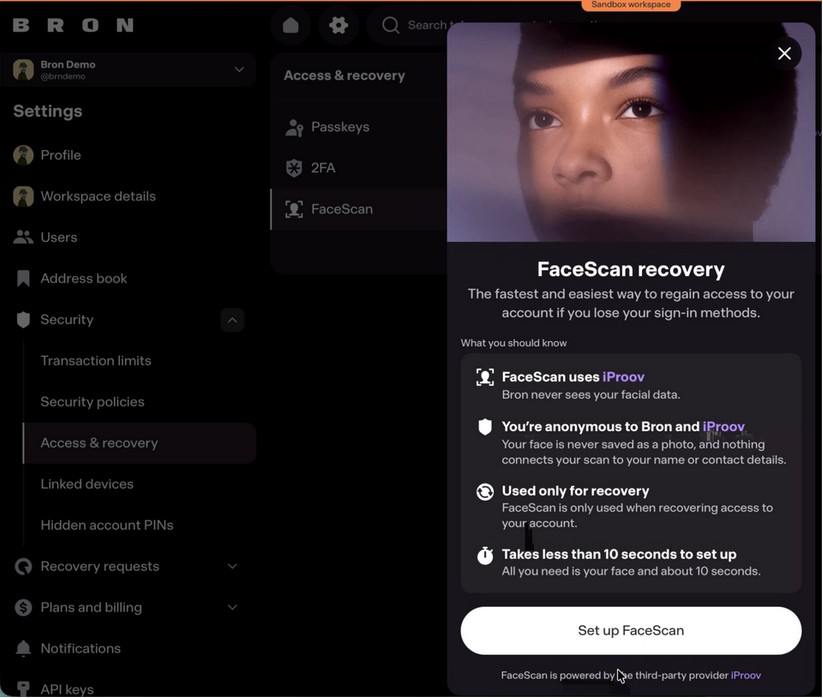
| Every device you sign with | A FaceScan check or codes from two Guardians | 48 hours |
| Every device, with neither method set up | Self-recovery, with an extended delay | Up to 30 days |
| Bron, if it ever shut down | Your device and Qrypt rebuild your signing key offline | Until Qrypt replies |
FaceScan is a liveness check run by iProov that needs no passport or ID documents. Guardians are people you trust and appoint; they never see your balances, cannot move funds, and a recovery needs codes from two of them. Both become usable 30 days after set-up, and the 48-hour wait gives the real owner time to spot and stop a recovery they did not start. Bron’s MPC library is open source, assessed by Trail of Bits and reviewed by CertiK, as its page on how Bron is secured explains.
For private holders, it is called inheritance
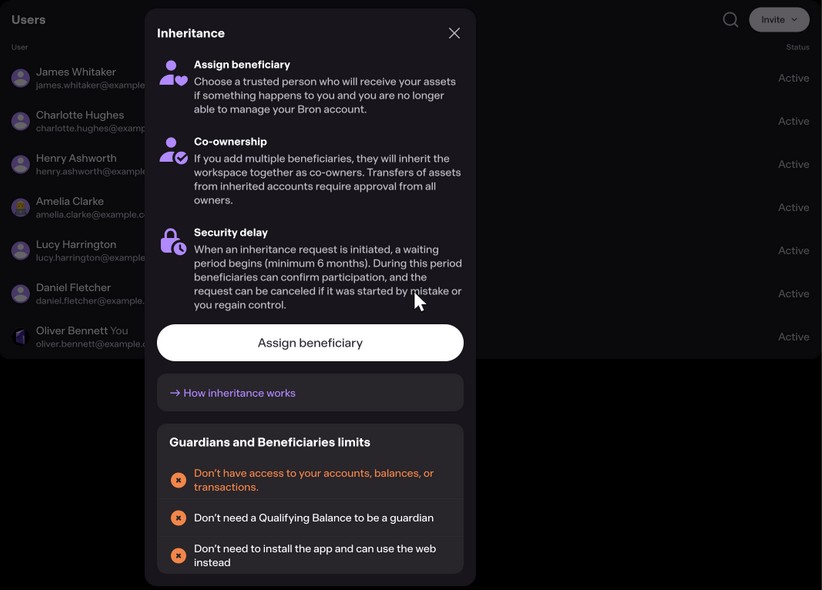
A will can say who inherits your crypto, but it cannot unlock a wallet. Bron lets you name beneficiaries who see nothing until a claim completes. Any of them can start one; a 12-month security delay then runs, or six months with codes from two of your Guardians, and you, any Guardian or any beneficiary can cancel it. It is not a dead man’s switch: nothing happens because you stop logging in.
Afterwards, the beneficiaries who joined become joint owners, and every transfer needs all the others to approve. Digital inheritance is included on every tier, and it does not replace your will.
Bron’s policy engine also allows joint family access while you are alive. A spouse can join as a second Owner or a Member, larger transfers can require two approvals, and a bookkeeper or accountant can be a Viewer who sees balances and activity but cannot move funds. Personal tiers include three team members.
For businesses, it is key-person risk
Many growing companies still rely on one founder with a hardware wallet in a drawer, or one finance lead who knows where the backup is. If that person leaves or dies, the company can lose access to its own money.
Bron for Business applies the institutional answer: staff prepare payments, authorised signatories approve them, larger transfers can require several approvers and accountants get view-only access. When someone leaves, you remove them; there is no phrase they could have photographed. If your business requires up to 3 members to operate the crypto treasury, Bron is free. If you have a larger team, the plan costs $250 a month, with everything included.
What to keep in mind
- Set up recovery on day one. FaceScan and Guardians cannot help in their first 30 days as Bron has a security delay for newly added biometrics and Guardians.
- You can still recover access if Bron fails. The offline route through Qrypt works without Bron, but requires receiving the e-mail from Qrypt if Bron disappears.
- It is built for serious balances. Personal membership needs a qualifying balance of $10,000, reached at least once during a 14-day trial.
The verdict
The seed phrase made every holder their own vault and their own locksmith, with no spare key. Institutions decided years ago that no fortune should hang on one piece of paper. Bron brings that standard to private holders and growing businesses, from people who ran it for institutions. If you hold more crypto than you could afford to lose, the question is no longer whether you can guard a seed phrase forever, but why you would want to.