RESTON, Va.--(BUSINESS WIRE)--#dating--Sextortion has emerged as one of the most dangerous forms of romance scams, preying on online daters and, tragically, claiming the lives of teenagers. Fraudsters use fake profiles to lure victims into sharing intimate content, only to threaten exposure unless a ransom is paid. Regula, a global developer of identity verification (IDV) solutions, shares a vision of how social media and dating platforms can strengthen protections to safeguard users.
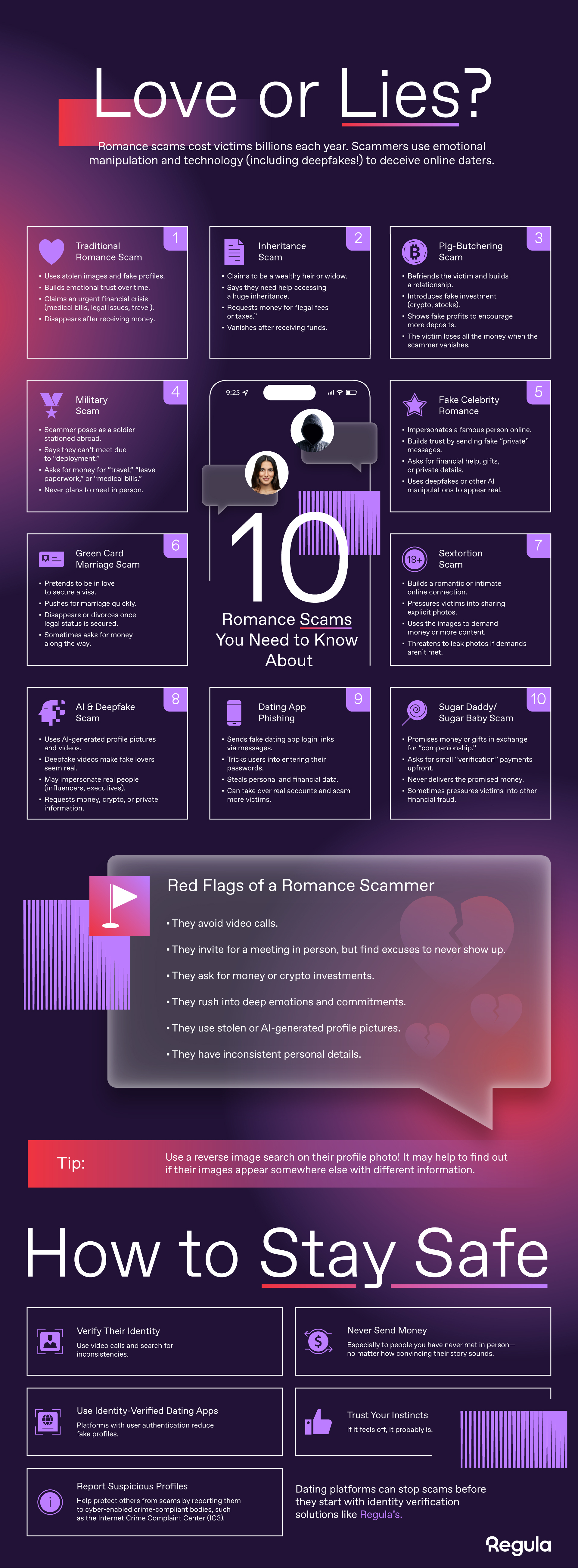

Romance scams come in many forms, exploiting trust and emotional vulnerability to defraud victims. Their common tactics include:
- Catfishing: Scammers create fake identities to build trust and manipulate victims.
- Military Scams: Fraudsters pose as deployed soldiers seeking financial assistance.
- Inheritance Scams: Victims are deceived with false claims of large inheritances requiring upfront fees.
- Pig-Butchering (Crypto Investment) Scams: Scammers feign romantic interest to lure victims into fraudulent investment schemes.
However, according to reports from leading child safety organizations, including the National Center for Missing and Exploited Children (NCMEC) and Thorn, sextortion is one of the most severe threats, with cases surging at an alarming rate. The FBI reported over 12,000 complaints in 2023 alone, resulting in millions in financial losses, severe psychological trauma, and, in some cases, even fatalities. Younger users and those new to online dating are particularly vulnerable.
Common sextortion tactics include:
- Fake Identities: Scammers pose as attractive singles, influencers, or even celebrities to build quick trust.
- Rapid Escalation: Conversations quickly shift from introductions to intimate exchanges.
- Blackmail Threats: Once explicit content is shared, scammers demand money, cryptocurrency, or further compromising images under the threat of exposure.
- AI-Driven Deception: Some scams leverage deepfake videos or AI-powered chatbots to manipulate victims.
The Role of Identity Verification in Preventing Sextortion
Sextortion thrives in environments where fake profiles and anonymity enable bad actors to operate freely. Social media and dating platforms play a critical role in combating this threat—through proactive moderation, AI-powered content monitoring, and user education. Stronger identity verification during registration is also a valuable tool in this arsenal, but it must be implemented thoughtfully, balancing fraud prevention with user privacy and accessibility.
Different online platforms use varying levels of verification, ranging from strongest to weakest:
- ID & Biometric Verification – Matching government-issued IDs with real-time selfies for authentication.
- Real-Time Selfies Without ID Validation – Confirming a live presence but without a verified identity document.
- Basic Checks – Verification through phone numbers, email, or linked social media accounts.
- Self-Reported Identity Without Validation – The least secure method, relying solely on user-provided information.
How Biometric and ID Verification Strengthens Security:
- Eliminating Fake Profiles: Biometric checks make it significantly harder for scammers to create fake accounts.
- Anti-Spoofing Technology: Prevents impersonation by detecting fraudulent attempts using photos or masks.
- Liveness Detection: Confirms a real person is present, preventing AI-generated deception.
“When faced with strong verification measures, scammers don’t simply disappear—they move to less secure platforms where they can continue their schemes unchecked. Standardizing biometric ID verification across multiple platforms would make it significantly harder for them to do so, creating a safer ecosystem across social media, dating apps, and other online services." – Jan Stepnov, Identity Verification Expert at Regula.
Empowering Users to Stay Safe
While platforms must take stronger security measures, users can also protect themselves by:
- Being Cautious of Fast-Moving Relationships: Avoid engaging in intimate exchanges early in conversations.
- Interacting with Verified Users: Prioritize connections with verified profiles.
- Reporting Suspicious Activity: Flagging blackmail attempts and scam behavior.
- Never Paying Ransoms: Complying with extortion often leads to further threats.
For more insights on how identity verification is transforming online dating security, visit Regula’s blog.
About Regula
Regula is a global developer of forensic devices and identity verification solutions. With our 30+ years of experience in forensic research and the most comprehensive library of document templates in the world, we create breakthrough technologies for document and biometric verification. Our hardware and software solutions allow over 1,000 organizations and 80 border control authorities globally to provide top-notch client service without compromising safety, security, or speed. Regula has been repeatedly named a Representative Vendor in the Gartner® Market Guide for Identity Verification.
Learn more at www.regulaforensics.com.
Contacts
Kristina – ks@regulaforensics.com