Private markets are going towards $25T, while retail investors still face high entry barriers. $IPO is positioned as providing retail access from $10 through token-based participation and curated deal screening. The model reduces entry cost, but outcomes depend on deal flow, allocation rules, and regulation.
What happens if private markets reach $25 trillion, but retail still enters late? That is the access gap behind this question.

Many private companies raise money through funds, insiders, and high-minimum deals first. Smaller buyers often wait until a public listing. By then, early pricing may already be over.
IPO Genie ($IPO) addresses this gap with a $10 entry model and $IPO tokenized access through token-based participation. It also includes AI-supported deal screening to help users review opportunities earlier in the process. It does not guarantee returns, and risk remains part of every decision.
So, can retail users truly access and review private-market opportunities before they become public?
Private Market AUM Forecast: $25T by 2030
Private market AUM, or assets under management, is moving toward a larger base. Ardian says private markets hold about $14 trillion today. It expects that figure to reach $20 trillion to $25 trillion by 2030.
PitchBook forecasts global private-market AUM near $26.7T by 2030. Preqin, now part of BlackRock, projects wider alternatives AUM at $32T by 2030.
This includes private equity, private credit, venture capital, and real estate. It also includes infrastructure, hedge funds, and natural resources. More companies stay private longer.
For retail investors, timing may matter as much as the company itself.
Retail Pre-IPO Access Gap in Private Markets
Retail investors usually reach pre-IPO companies late. Private-market entry often depends on large checks, accredited-investor status, and private networks.
Traditional minimum investments can start near $250,000 and move above $1 million. Lockups can also run 7-10 years, which keeps capital locked for long periods. Recent pre-IPO news shows the scale of this gap.
TechCrunch reported that Anthropic filed to go public. It also reported a $65 billion Series H round and a $965 billion post-money valuation.
Canva gives another example outside Frontier AI. PitchBook reported Canva’s secondary share sale valued it at $42 billion.
These examples show how major value creation happens in private markets, while retail investors remain limited until public listings. By then, much of the early growth and price discovery may already be priced in.
This access gap is where IPO Genie places its tokenized private-market model.
How $IPO Delivers Tokenized Access from Just $10
IPO Genie’s whitepaper outlines a token-based access model starting at $10. It aims to reduce entry barriers compared to traditional private markets. Minimum investments in those markets often range from $250,000 to over $1 million, according to industry estimates.
The $IPO token works as an access layer inside the platform. It may allow users to view deal summaries, use screening tools, and move through tier-based access levels. In typical private-market structures, fewer than 10% of investors gain early-stage access due to accreditation and capital limits.
The model focuses on access to information and early deal review, not guaranteed ownership or returns. Its effectiveness depends on deal flow, platform rules, and regulatory approval.
Compared with traditional markets, the key difference is lower entry cost and earlier access to curated deal data.
$IPO: The Access Token Giving Retail Entry from $10
$IPO functions as the platform access token used for deal access, governance participation, staking, and allocation-related features.
The total supply is listed at 437 billion $IPO. Allocation is divided into 50% presale, 20% liquidity and exchanges, 18% community rewards, 7% staking rewards, and 5% team allocation. The team allocation is subject to a 2-year lock with vesting conditions, based on project disclosures.
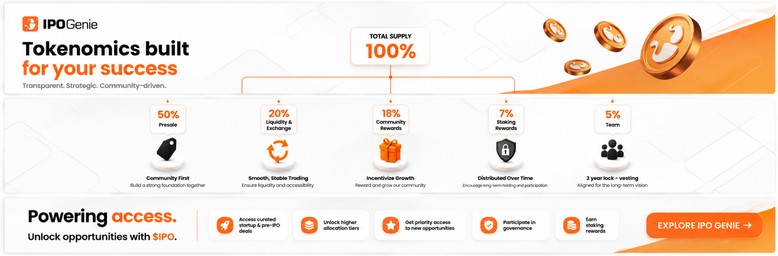
The model is structured around reusable access, where tokens may be used across multiple deal cycles depending on platform rules. The value is presented as reduced entry cost into private-market-style opportunities rather than investment return.
Outcomes depend on deal flow, user participation, and regulatory approval for tokenized systems.
AI Deal Screening and Vault Testing on the $IPO Platform
IPO Genie describes its AI layer as a deal-review system, not a return predictor. Its whitepaper says the system scans startup data, founder records, traction, and sector data. It also reviews funding rounds, GitHub activity, Crunchbase updates, and social sentiment.
It also mentions AI agents that run 24/7. These agents can flag missed KPIs, compliance issues, new partnerships, and strategic investors. The goal is continuous review, not one-time scoring.
IPO Genie materials also mention a 0-100 risk-adjusted score. That score can review team quality, tokenomics, market strength, community data, and security checks.
Genie Vault is IPO Genie’s public test for AI deal screening. Vault 1 focused on Redwood AI Corp. (AIRX) before its February 2026 listing. Vault 2 tests whether the screening process can repeat with new deal activity.
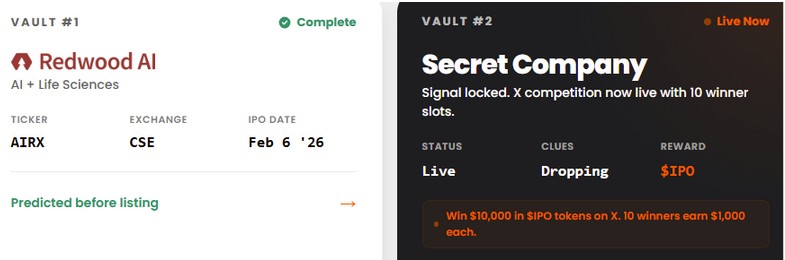
This makes pre-IPO deal screening more structured. For retail users, the AI layer may work as a comparison tool. It still cannot remove private-market risk.
Can $IPO Turn $10 Into Early Private-Market Access?
Private markets may reach $25 trillion, but retail access still depends on timing and entry limits. IPO Genie links its model to a low-cost entry, AI-supported screening, and $IPO-based access. It shows how $10 participation may open access to private-market opportunities.

The system may allow users to review early-stage opportunities before public listing. Its effectiveness depends on deal flow, allocation rules, platform usage, and regulatory approval. Without these, access remains limited.
The model is positioned as an early-stage tokenized access system, where value depends on execution rather than entry price.
Stay Safe: Verify contracts, audits, and the official website before joining any presale. Avoid unofficial groups, copied ads, and unknown wallet prompts.
Official channels include the IPO Genie website, Telegram, and X community.
Disclaimer: This article is for informational purposes only. It is not financial advice. Always conduct your own research and consult a licensed financial advisor before investing.
Disclaimer: The statements, views and opinions expressed in this article are solely those of the content provider and do not necessarily represent those of Crypto Reporter. Crypto Reporter is not responsible for the trustworthiness, quality, accuracy of any materials in this article. This article is provided for educational purposes only. Crypto Reporter is not responsible, directly or indirectly, for any damage or loss caused or alleged to be caused by or in connection with the use of or reliance on any content, goods or services mentioned in this article. Do your research and invest at your own risk.