From the onset, THORChain and Uniswap are decentralized exchanges (DEXs) that facilitate the exchange of crypto assets between traders. Being decentralized means they are not operated or owned by a single entity. Since it is built on the Ethereum blockchain, it is compatible with the MyEtherWallet and MetaMask.
The transactions are completed through smart contracts without third parties or intermediaries. For instance, Uniswap uses Exchange and Factory smart contracts.
DEXs are the complete opposite of the centralized platforms, which have custody of users’ assets akin to banks. But how is Uniswap different from THORChain? Before we jump into the differences, we shall briefly explore the basics of these platforms.
About Uniswap and THORChain
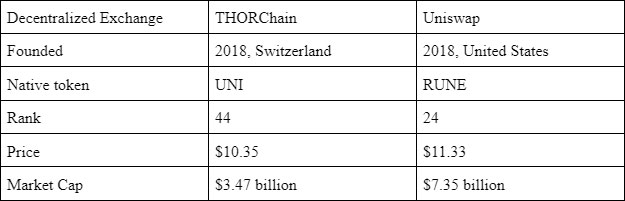
Uniswap V3 is the largest decentralized exchange built on the Ethereum exchange, Uniswap is as of now traded at roughly 11 USD per coin, however, the most UNI predictions are not particularly positive as the coin is forecasted to decrease by roughly 5% before the end of the year.
The open-source automated liquidity protocol prioritizes security, decentralization, and security resistance. Open-source means you can copy the code to create your own DEX. In fact, it allows people to list their coins for exchange. In addition, owners have control of their funds by retaining private keys. This reduces the risk of losing your assets in case of hacking.
THORChain is an autonomous and decentralized cross-chain liquidity network. This means that it has liquidity pools that allow users to swap tokens from different chains.
Now let’s examine the difference between Throchain and Uniswap.
THORChain and Uniswap Key Differences
Trading Volume
Uniswap is relatively bigger than THORChain. It handles a daily trading volume of over $1.2 billion, almost thrice the volume of close competitors. Additionally, it is the largest DEFI platform with a $17.84 billion Total value locked (TVL). Uniswap
The updated version allows you to swap any ERC20 tokens. The platform has 476 listed coins and enables traders to exchange 914 crypto pairs.
THORChain ranks 17th biggest decentralized exchange by trading volume. It handles a $57.7 million daily turnover. It currently has 31 pools with a total value locked $1.15 billion total value locked. It has handled $6.2 billion on-chain swaps. ThorChain is predicted to stay around the 10 USD mark this year.
Uniswap listed coins shadow THORChain’s, which has 24 listed coins and 25 pairs.
Native Coins
UNI is the native token on Uniswap. It was created in 2020 to prevent traders from eloping to other DEXs, especially Sushiswap, which was poaching traders from Uniswap. The token gives users voting rights on the platforms changes and development, token minting methods, and fee changes.
On the other hand, THORChain uses RUNE for token swaps. It is used as the liquidity pool pair for all native coins when converting tokens from foreign blockchain to THORChain. This means you don’t have to submit liquidity pairs as it happens in other Decentralized exchanges.
Fees
Swaps on the THORChain network attract fixed charges and dynamic fees based on slippage. The latter means that the swaps with higher slippage attract higher fees. Therefore bots have a hard time attracting value from swaps, for example, during a sandwich attack.
The fees on THORChain are
- Value capture – captures value from users accessing the resources (liquidity) and pays resource providers.
- Access control – increases the fees when demand rises.
- Resource subsidization – swap consumes resources such as networks, CPU, and memory resources from validators. THORChain charges a flat fee that caters to extra and integral resources. The chain’s base asset pools pay on the gas consumed. For example, the ETH pool caters to Ethereum fees.
Outbound Fees cost three times the chain’s stores gas fee. For instance, the typical gas fees for bitcoin are $1, $10 for Ethereum, and $0.03 for the Binance Chain.
Uniswap has varying fees for various token pair pools. Liquidity providers can create pools using three pool fees tiers: 0.05%, 0.30%, and 1%. Governance proposals can add other charges. This enhances pool functionality which was underserved by a 0.30% swap fee.
Speed
The speed in THORChain networks depends on the blockchain networks between which swaps occur. For instance, a swap between bitcoin to ether would take around 13 seconds: 10 seconds on the bitcoin block plus execution time on THORChain and outbound Ethereum transactions.
Uniswap has a limited transaction time. The transaction deadline is 20 seconds, after which it fails automatically. You can, however, perform the transaction again.
Swaps
One of the biggest differences between the two platforms is the swapping. Uniswap only allows users to swap ERC20 tokens. Therefore, trading assets from other blockchains will need you to wrap or change them into synthetic tokens.
THORChain, on the other hand, supports the swapping of tokens between two blockchains without necessarily wrapping the tokens. THORChain uses a threshold signature scheme to store schemes.
Consensus Mechanism
Thorcahin is Tendermint based, meaning it uses Byzantine Fault Tolerance (BFT) consensus mechanism. In addition, it uses proof of stake consensus mechanisms for Sybill resistance. The PoS consensus protocol variation is known as Proof of Bond and requires a commitment of 1 million RUNE tokens for transaction validation.
Similarly, Uniswap uses proof of stake consensus mechanisms. Remember, it is built on the Ethereum blockchain, which started migration from proof of Work to Proof of Stake.
Despite the differences, the two platforms have several similarities. The biggest is arbitrage trading.
Arbitrage trades find tokens trading above or below the average market price creating an imbalance. The whole point is to buy or sell until the price is in balance with the prices on other exchanges. In Uniswap, the initial deposit into the liquidity pool sets the pool’s initial price. They are incentivized to set the price equal to the token value; otherwise, they create an arbitrage opportunity.
Final Note
Decentralized exchanges are on the verge of growth. Uniswap is well established and is performing exemplarily, especially after launching more enhanced versions. THORChain is closing the gap, thanks to its distinctive cross-chain swaps feature. It can catch up with Uniswap if it increases listed coins and, in turn, TVL. Ensure you consider fees and other factors before settling for a decentralized exchange.