The market for Solana real-world assets is growing rapidly. In June 2026, this market recorded almost $967 million in net inflows, more than any other blockchain during the same period. The growth of Solana’s RWA market is due to increased liquidity in stablecoins and RWAs, making Solana an attractive alternative for DeFi and digital settlements. In this context, many traders look for ways to swap ETH to SOL.
This article explores the causes of this growth, the role of stablecoins, and the importance of this trend beyond crypto trading.
What Is Driving Solana RWA Growth in 2026?
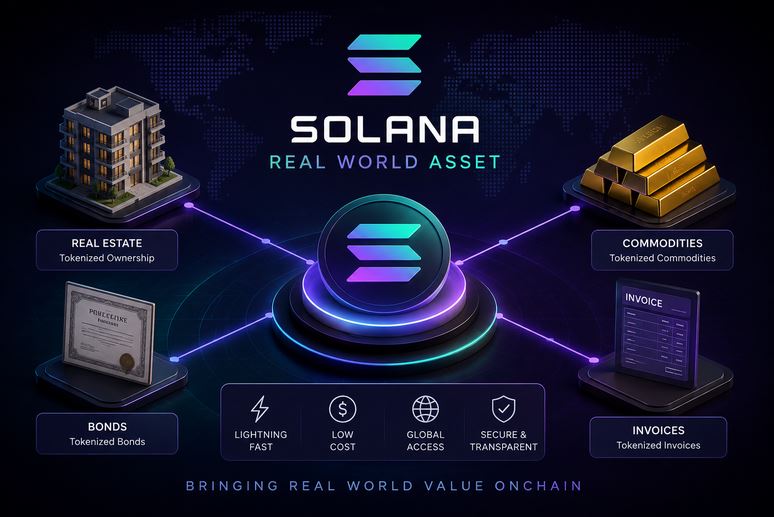
Before diving deep into the reasons driving Solana RWA growth, it’s important to first understand what it is. RWAs are tokenized representations of real-world assets on a blockchain.
They can be used to represent equities, credit-related assets, treasuries, or any other real-world financial product. The tokenization of RWAs helps enhance liquidity by exposing them to a new set of investors, enables fractional ownership of large or expensive assets, and provides greater transparency.
In this case, RWAs on Solana are gaining traction thanks to the blockchain’s optimal performance. Solana’s transactions are settled in seconds, and fees are usually lower than $0.01. Moreover, it’s one of the most traded cryptocurrencies, with a strong community of users and developers.
In May 2026, the Solana RWA market reached a new mark, with over $2.8 billion in total value and over 230,000 RWA holders. Besides that, it also holds a 97% share of cumulative tokenized equities in spot trading.
These figures are evidence of the growing support and trust investors place in Solana. By early July, it’s among the most-traded cryptocurrencies, with over $2.5 billion in daily trading volume.
How Stablecoins Support Solana RWA Activity
In parallel with RWAs, the stablecoin market on Solana has also grown in recent months. During May, stablecoin supply reached $16.4 billion. But this is not a mere coincidence. In fact, stablecoins support the growth of the RWA market.
The volatility of the SOL token can be counterproductive for the tokenization of RWAs. So, stablecoins provide a token with a fixed value that can be used to settle contracts and interact with assets more easily.
This way, users can price and trade RWAs without having to switch back to fiat currencies and traditional banks.
Why Solana RWA Could Matter Beyond Crypto Trading
The uptick in Solana’s RWA market is not a result of a new trend in the crypto ecosystem. Rather, it is the expected outcome of Solana’s focus on bridging the gap between financial markets and everyday traders.
The project has stated its goal to make global financial markets accessible to anyone with an internet connection. This is achieved by tokenizing stocks, equities, and other classes of assets from different regions and markets around the world. Once on the blockchain, there are no regional boundaries that could stop investors anywhere from participating in these markets.
Solana, then, invites institutions to tokenize their assets and make them accessible on the blockchain. Unlike more speculative crypto trends, RWAs are rooted in real, solid off-chain markets, so they’re unlikely to be a short-term trend.
Final Thoughts: Is Solana RWA the Next Stablecoin Growth Story?
Tokenized real-world assets are bringing significant value to Solana and contributing to its overall growth. Stablecoins and tokenized equities bring more liquidity to the market and grow together, making Solana more relevant for payments and financial markets.
Moreover, this growth can accelerate, spurring more assets to be tokenized on the blockchain and significantly increasing liquidity and trading volume. However, it’s important to remember that profits are never guaranteed, and the crypto ecosystem is inherently risky.
RWAs on Solana are also vulnerable to regulatory limits, liquidity issues, questions about asset quality, custody risks, or even risks related to the platform. Despite that, it’s definitely worth keeping an eye on the Solana RWA market. If stablecoin liquidity continues to grow, it could support the growth of RWAs.
But every trader must keep in mind that, before making any investment, it’s crucial to research each asset, platform, and transaction carefully. This is the surest way to reduce the risks associated with crypto investments.
FAQ
Will Solana benefit from stablecoins?
Solana is already benefiting from the increased liquidity of stablecoins and tokenized RWAs. This brings new users to the blockchain and increases daily trading volume and market capitalization, which in turn boosts the value and popularity of the SOL token.
How will Solana do in 2026?
Since June 2026, the price of SOL has started to increase after a few months of bearishness. While the future price of cryptocurrencies cannot be predicted, recent developments and the token’s performance could indicate a positive trend in the second half of 2026.
Is Solana gaining ground?
Solana has established itself as one of the leading blockchains in the ecosystem. It features a solid, scalable DeFi and dApps ecosystem, and its focus on RWAs has been well received by the investor community. It currently ranks #7 by market capitalization, with a market value of $47.63 billion by early July.
What are the trends in stablecoins in 2026?
Stablecoins in 2026 are definitely linked to the rise of RWAs, as this article has shown. However, this year has also seen a wider adoption of stablecoins as a payment method, especially for cross-border transactions. Adoption by banks is also growing, and could mark new developments in this industry during 2026.